

For over five years, J.K. Rowling has spoken frankly about the transgender issue. In a famous June 2020 essay, she affirmed her belief in the reality and salience of biological sex, citing motivations which included women’s rights and freedom of speech. I was inspired by the piece and, a few months after reading it, expressed my agreement with the position publicly; I have never regretted doing this.
But over five years after the publication of the essay, I have been looking for an opportunity to take stock of the evolution of Rowling’s stance, the state of this broader topic and the implications from an ideological perspective. Last week, Rowling published a shorter essay on X which, in my opinion, illustrates some of the ways in which her position has changed. As I will argue, I have reservations about these changes and, given Rowling’s 2020 views were a reference point for my own, would like to set out my grounds of disagreement. Though many others have analysed Rowling’s changing stance (often in hostile terms), I hope that my particular perspective (still somewhat sympathetic, but critical) will be of interest.
To do this, we must analyse the basis of Rowling’s stance(s). On one level, the gender-critical position is a set of attitudes. Answering the YouGov questions in the table below, the Rowling of 2020 and 2025 would disagree with almost every question. As the table shows, high proportions of the British public have similar attitudes to Rowling, as do I.
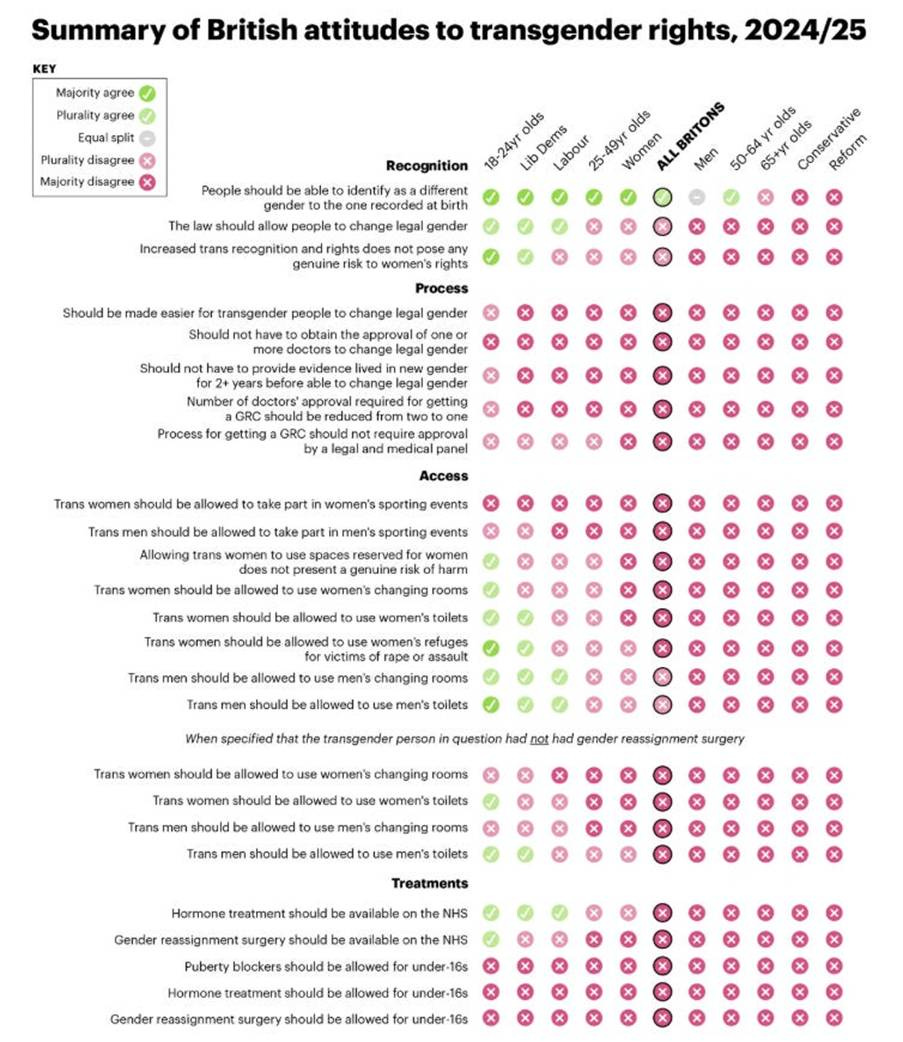
Yet taken in isolation, attitudes convey limited information. Rather, their organization (or not) with distinct ideologies is more important and, considering this question, we may usefully apply Freeden’s morphological approach to ideology. This stipulates that ideologies have core, adjacent and periphery concepts which ideologues (a non-pejorative term here) combine in different ways. Conservatism, for example, combines core concepts such as organic change with adjacent concepts such as patriotism. Alternatively, liberalism combines core concepts such as freedom and individual fulfilment with adjacent concepts such as democracy and equality.
Several ideologies are consistent with disagreement with the YouGov questions. For example, radical right populists and conservatives would also disagree with them. Yet in the case of Rowling’s 2020 essay, I was attracted by its liberalism. Individual fulfilment is a core liberal concept and, in her essay, Rowling emphasized the right of transgender people to live safe and happy lives. There might be certain conflicts with the rights of biological women, yet these could be resolved through careful trade-offs, as is customary in liberal democracies. She spoke of a transgender woman friend (‘I’ve always found it hard to think of her as anything other than a woman’) and asserted that transgender people deserved respect and protection,
‘I believe the majority of trans-identified people not only pose zero threat to others, but are vulnerable for all the reasons I’ve outlined. Trans people need and deserve protection. Like women, they’re most likely to be killed by sexual partners. Trans women who work in the sex industry, particularly trans women of colour, are at particular risk. Like every other domestic abuse and sexual assault survivor I know, I feel nothing but empathy and solidarity with trans women who’ve been abused by men… I want trans women to be safe.’
Elsewhere, Rowling expanded on this. In an X (then Twitter) post during the same period, she promised to ‘march with [trans people if they] were discriminated against on the basis of being trans.’
More broadly, the 2020 essay was an assertion of the right to dissent. At the time, disagreement with transgender rights activists was very difficult; dissenters could be sacked and/or subject to physical threats. Of course, the right to dissent is fundamental to liberalism, part of the core concept of freedom. From Thomas Paine to Anna Politkovskaya, many liberal heroes have refused to submit to authoritarians and, in its firm but measured manner, Rowling’s essay was in this tradition,
‘It would be so much easier to tweet the approved hashtags – because of course trans rights are human rights and of course trans lives matter – scoop up the woke cookies and bask in a virtue-signalling afterglow… Huge numbers of women are justifiably terrified by the trans activists; I know this because so many have got in touch with me to tell their stories. They’re afraid of doxxing, of losing their jobs or their livelihoods, and of violence. But endlessly unpleasant as its constant targeting of me has been, I refuse to bow down to a movement that I believe is doing demonstrable harm.’
Five years is a long time. Since then, Rowling has faced abuse which I cannot imagine. In November 2021, she wrote of having ‘received so many death threats I could paper the house with them’. Here, I have nothing but sympathy for Rowling and appreciate that such experiences can focus one’s mind. Nonetheless, those of us who agreed with her in 2020 are under no obligation to continue doing so. Legitimately, we may ask whether Rowling has stuck to the liberalism which characterized her initial interventions.
In recent years, one is struck by the extent of Rowling’s focus on this issue. For example, about three quarters of her recent X output concerns the transgender issue. In itself, concentration on a single topic does not herald a move from liberalism; many single-issue groups are liberal.
Yet in practice, one worries that laser focus on a single issue can lead away from liberalism. Typically, single-issue communities argue that their cause is of the utmost importance. If this is not the case, why invest so much time in it? But from a philosophical perspective, such attempts are problematic. As Marius Ostrowski notes, reality is multi-faceted and narrow ideological readings can never capture its complexity. In the case of the gender-critical movement, there are obvious objections. What about an existential threat such as climate change? What about international conflicts? What about socio-economic equality? Rowling’s cause is an important one, yet it has multiple competitors and some of them are more important.
But to maintain the impression of hyper-salience, the single-issue campaigner must present their cause in Manichean terms which attempt to force one to pick a side, thus expanding the conflict. For years, progressive activists such as Greta Thunberg have used such tactics. In last week’s essay, Rowling struck a similar note,
‘Either a man can be a woman, or he can’t. Either women deserve rights, or they don’t. Either there’s a provable medical benefit to transitioning children, or there isn’t. Either you’re on the side of a totalitarian ideology that seeks to impose falsehoods on society through the threat of ostracisation, shaming and violence, or you’re not. The alternative to being ‘blunt’ - using accurate, factual language to describe what was going on - was to surrender freedom of speech and espouse ideological jargon that obfuscated the issues and the harms caused. We’ve always needed blunt people, but we need them most of all when being asked to bow down to a naked emperor.’
Here, the logic of the single issue leads Rowling away from liberalism. Reflecting their pluralism, liberals should be suspicious of attempts to divide society into rival groups, precluding compromise. In this case, Rowling conflates the genuinely binary matter of biological sex with ones concerning women’s rights and the importance of the transgender issue which are much more complicated.
We may have broader questions. What if people do not regard transgender rights as an immediate priority? As we have noted, the world faces multiple challenges, many of which are more important than the transgender issue. What if people do not want to speak publicly about this topic? The tone of the debate is scarcely attractive and liberalism also stands for the right to remain silent. What if the silence of some reflects their commitment to other campaigns which they do not wish to jeopardize? What if the success of the gender-critical movement conflicts with liberal-democratic rights? In the event of a public inquiry into gender services for children, one would worry about Rowling’s (‘the doctors involved [should] all be in jail’) priorities.
In other ways, Rowling’s position has hardened. The respect for the dignity of transgender people, evident in the 2020 essay and part of liberalism’s core concept of individual fulfilment, has receded. On several occasions, she has dismissed transgender people in derogatory terms – referring to a transgender woman as a ‘man’ is far from the language of her 2020 essay – and exposed individuals with no public profile to the ire of her 13 million X followers.
Unfortunately, this is a broader trend in the gender-critical movement. The case of Graham Linehan, whose negative partisanship has even led him to troubling positions on other issues, is the most extreme. Certainly, Rowling has not gone as far as this and, of course, is not responsible for Linehan’s positions, yet the pattern is clear. Rather than being organized with liberalism, gender-critical attitudes are increasingly being arranged with conservative and/or authoritarian ideologies.
What happened to the movement of dissenting liberals, embodied in Rowling’s 2020 essay? Several factors have played a role, not least the appalling behaviour of some of the movement’s opponents, yet one notices the changed societal dynamics. In 2020, the gender-critical campaign was a movement of plucky underdogs; the law, media and political classes were broadly against it.
This is no longer the case. The law has become more favourable and the media is more sympathetic. In politics, the case of the UK Labour Party is illustrative. In 2020, transgender rights activists were ascendant in the party and few dared oppose them vocally. In 2025, the party has adopted several gender-critical positions. I am aware that the picture is not unambiguous – in sectors such as academia and the arts, conditions remain difficult – but, overall, the gender-critical campaign is winning.
Yet the movement is struggling to come to terms with its success. An odd dynamic prevails; the environment is becoming friendlier, yet the campaign is becoming more militant. As with other movements – the parallels with the 2010s LGBTQ+ rights campaign are strong – the gender-critical movement has struggled to come to terms with its success. As worthy victories have been won, a large and energetic movement has found it difficult to pause. Rather, momentum has taken it to less defensible causes and tactics.
Some of Rowling’s 2020 admirers will agree with such strategies. Others will not and have the right to dissent.
If you enjoyed reading this, do think about subscribing! Subscription is free – all it means is that you’ll receive a weekly email. But every new subscriber makes me very happy 😊 😊 😊
What happened? Amazingly she stayed sane under an onslaught that would break lesser people. Why are YOU so obsessed with this?
"What about an existential threat such as climate change? What about international conflicts? What about socio-economic equality? Rowling’s cause is an important one, yet it has multiple competitors and some of them are more important."
The "Why do you even care? How does it even affect you? Don't you have better things to think about?" brand of trans boilerplate.
Coming to terms about the nature of reality and the nature of knowledge is the the prerequisite for all those other "more important" causes.